Special Edition No. 1 · Ronald Barnett Lecture
Civic, Global, Ecological: Towards a Collaborative Mission for the University
Slide 7 – The Ecological University
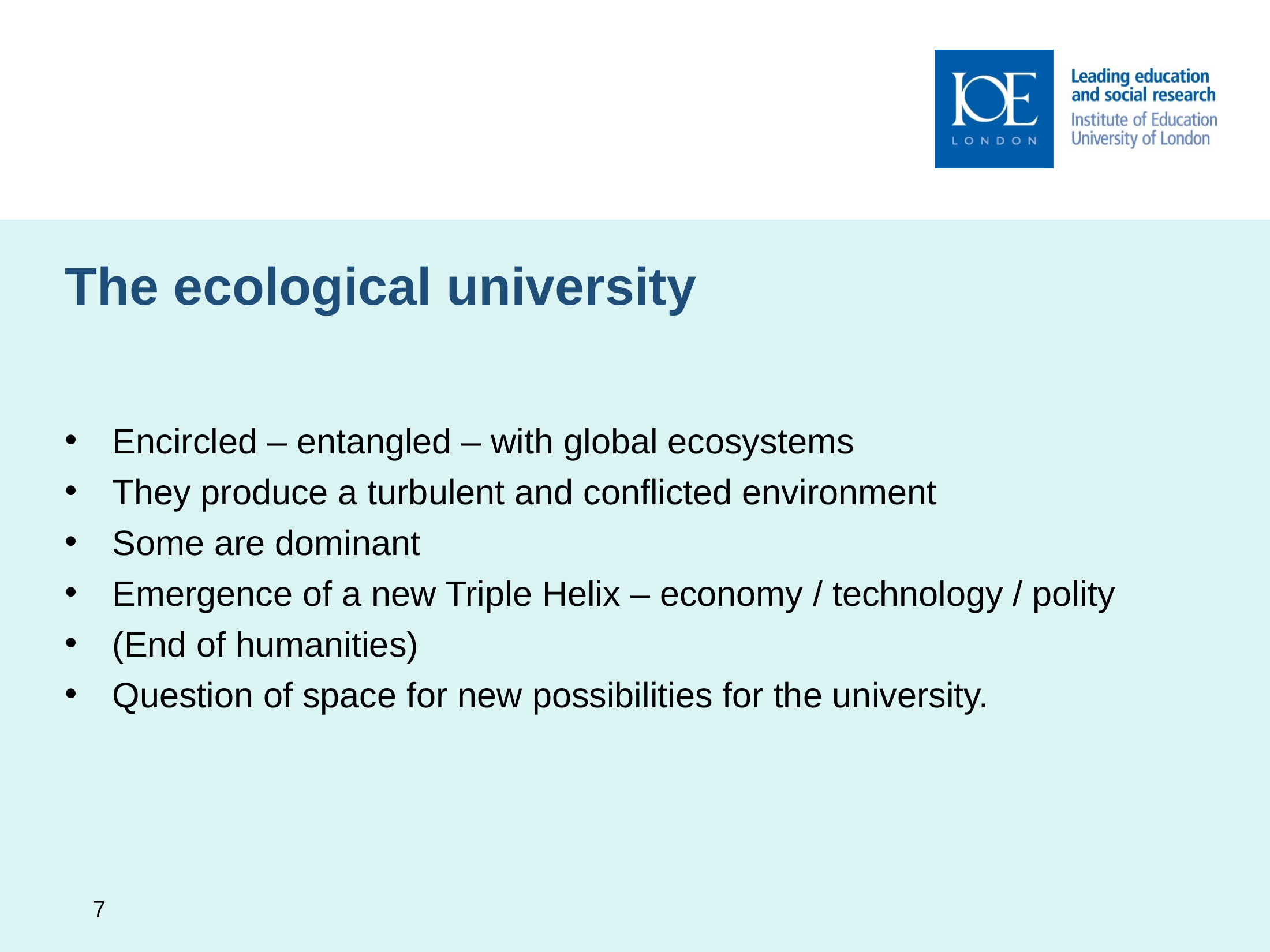
This diagram, with its intertwined ecosystems, is intended to convey a sense of the university being buffeted and challenged by these mega-ecosystems. Every university across the world, whether it understands this or not, is in this situation, at least to some degree.
This is producing a turbulent and conflicted environment in which universities find themselves.
What you are all interested in is management, so why is management becoming so difficult in large organisations such as universities?
It is because of the turbulent and conflicted environment within which universities now have to operate. That is often said, but perhaps it is not sufficiently recognised just how turbulent and complex that environment is.
Ecosystems are buffeting and challenging the university, but they are not all equal. Some of these mega-ecosystems are more powerful than others. Some are dominant.
We are now witnessing the emergence of what I would call a new Triple Helix.
Many of you will be familiar with the original idea of the Triple Helix, which entered the literature some twenty or thirty years ago. But I want to suggest that we now have a new Triple Helix consisting of:
- the economy,
- technology, and
- the polity, especially the state.
These three are acting together in very powerful ways upon universities. Of the nine mega-ecosystems, these three are particularly dominant; this triumvirate of forces acts in concert.
The result: the ending of the humanities across much of the world.
Now, I do not know exactly what the situation is in Japan. My understanding, however, is that universities in Japan are moving in the same direction as universities in many other parts of the world, with the humanities gradually being withdrawn from the higher education space.
This is a consequence of the way in which the economic system, new technologies, and politics are increasingly coming together. As these three mega-ecosystems converge, there is progressively less space for the humanities. Collectively, their interests lie in economic growth, the defence and increase of capital, control of systems (including human beings now understood as systems), instrumental reason and a corralling of life itself into digital regimes.
The question before us, therefore, is whether there is still space for a new possibility of and for the university in the twenty-first century.
I am suggesting that the space available to universities is steadily narrowing because of these immense forces acting upon them. The question is whether that space can once again be widened, enabling universities to embrace new possibilities in the twenty-first century.
Slide 8 – The Three Territories
I would ask you to hold that image of those mega-ecosystems surrounding and entangling the university in your mind as I go through the rest of my talk. That image is fundamental to everything else I want to say.
We now return to my starting point: the three territories—the civic, the global, and the ecological.
The question is: What does it mean for a university to live in all three?
Given the ways in which universities are being constrained and steered in the direction of technology, the economy, and the interests of the state, can universities properly and seriously engage with each of these three possibilities—these three territories that open up before them: the civic, the global, and the ecological?
Slide 9 – Snares of Nests
So, how do we understand those three territories: the civic, the global, and the ecological?
How might we represent them? If we were to draw a diagram, what would it look like?
Some might suggest that the four territories are nested, one within the other. The civic is nested inside the national, the national inside the global, and the global nested inside the ecological.
It is rather like those Russian dolls. You start with a large one. Inside it is a smaller one, and inside that is another smaller one.
Everything appears straightforward. The university can attend to all the locales simultaneously. There is no problem—it is simply a matter of scale and horizon.
I want to suggest that it is more complicated than that.
Slide 10 – The Proliferation of the Units
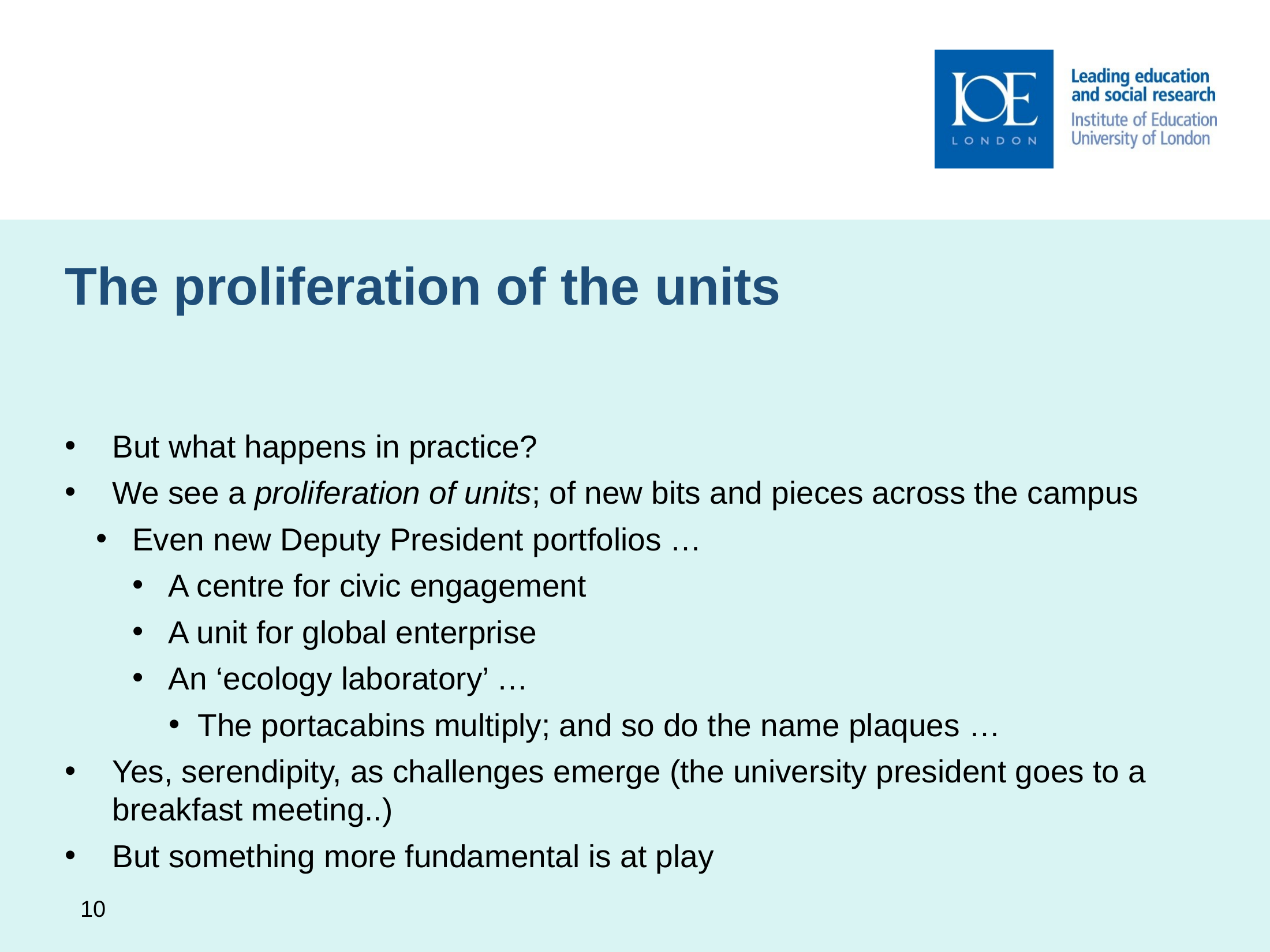
What happens in practice?
What is happening around the world is that universities are becoming increasingly sensitive to a wide range of different challenges.
How do they respond?
First of all, the portfolios of the deputy presidents expand. You have a Deputy President for Enterprise. You have a Deputy President for Regional Activities. New units and new offices begin sprouting up across the campus.
Because universities very often do not have enough space for new buildings, temporary accommodation also begins to appear. You have a Centre for Civic Engagement, a Unit for Global Enterprise, an Ecological Laboratory. Temporary huts and offices spring up across the campus as the university pushes and pulls itself in different directions.
So, what is happening here?
The university is fragmenting, rather than forming a coherent view of itself. It is fragmenting and moving off in all sorts of different directions.
This is a highly dynamic situation, one in which the different parts neither know about nor much care about the other parts.
The university president goes to a breakfast meeting with other university presidents in Japan, hears a new idea about responding to the Internet and artificial intelligence, and comes back and launches another initiative.
The university then moves off in yet another direction.
Serendipity rules. Chance rules. Things simply happen in a fragmented way.
But something even more fundamental is at stake here.
Slide 11 – A Situation of Multiple Constituencies
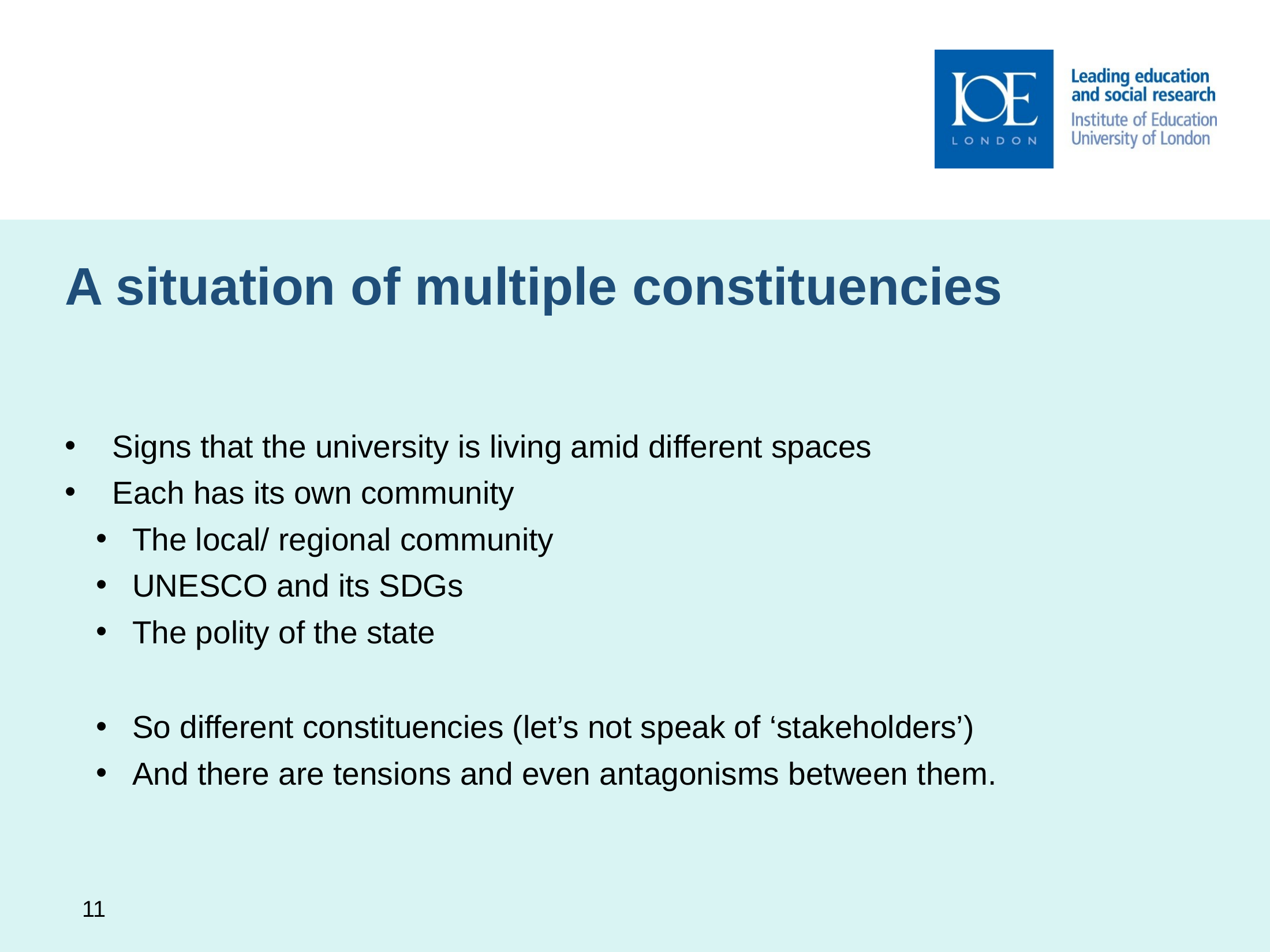
The university is not alone, as I have been implying. It has to respond to these mega-ecosystems, which are acting upon it with enormous force and traction.
The university is responding to all manner of different influences and communities.
It has its region, its locality. In large cities, there are powerful councillors, presidents, mayors, and public officials expecting their local university to advance local and regional interests in all sorts of ways.
You have the state and the national government setting expectations for universities within an increasingly political environment.
Then there is a world view. You have the United Nations, you have UNESCO and its Sustainable Development Goals, to which, I think, Japan is particularly sensitive. You are doing a great deal of work on the environment and sustainability front.
And the university has to respond to these communities. They are out there, calling on universities to respond in different ways.
And they all speak different languages, springing from different interests, different networks, different values and different orientations to the world.
There are different constituencies out there, and there are tensions and antagonisms between them. They do not agree with each other, and they place quite different and mutually contradictory expectations upon universities.
Slide 12 – Messy Turbulence
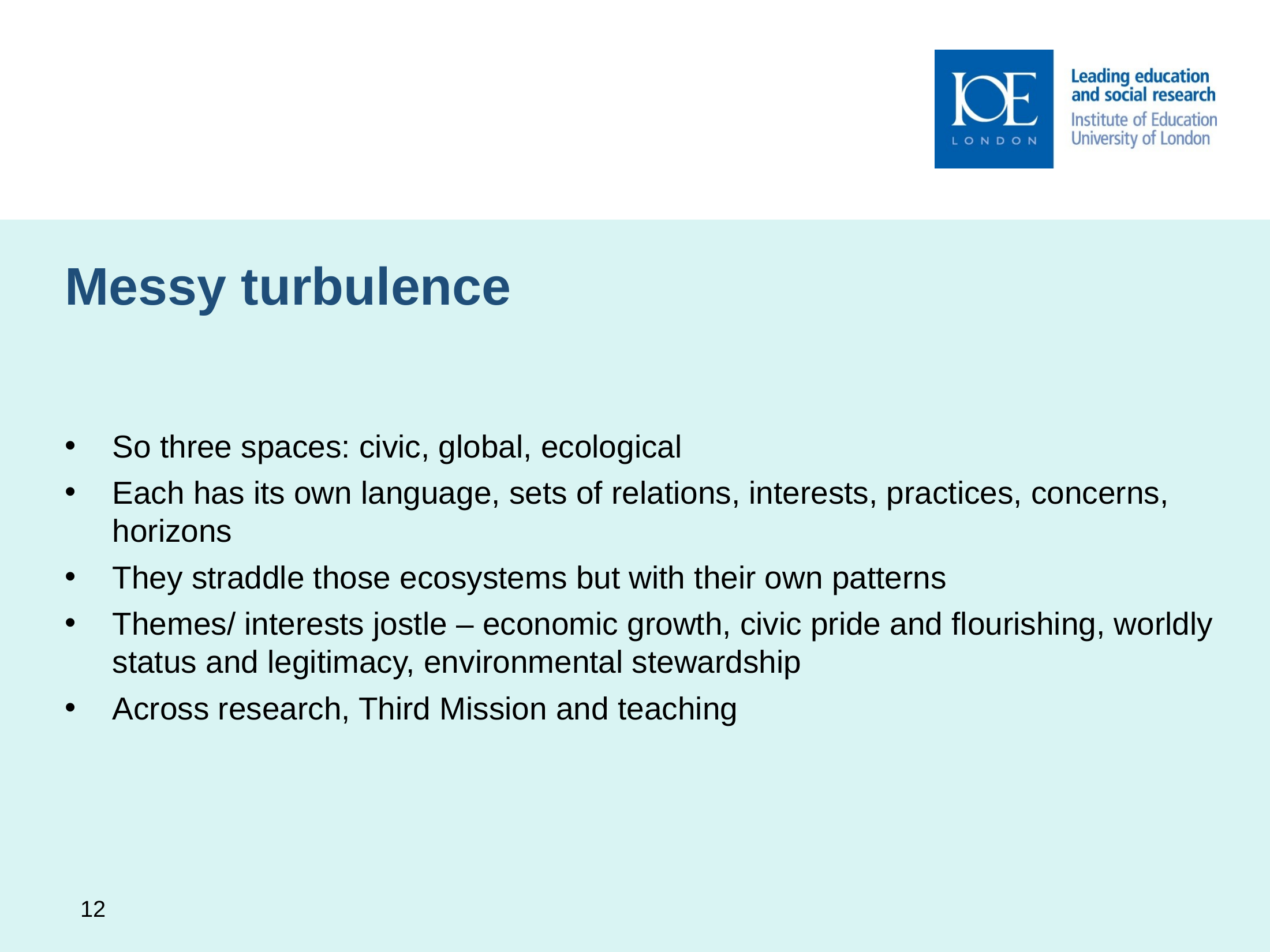
This is a situation of great turbulence for universities across the world.
The civic, the global, the ecological—and by ‘ecological’ I mean the university having an eye to the world of Nature but doing so through its entanglements with all the other ecosystems. (The university can only properly attend to Nature if it understands that the matter of Nature is, in part, a matter of the economy, culture, learning, knowledge, the polity and so forth.)
This is a great challenge for university leaders and managers because they are hearing and sensing these different communities. They are sensing these demands throughout the university. These challenges, these languages, these ideas, and these expectations all have to be translated into a language that the university itself can understand.
And the professor in the humanities and the professor in technology are going to interpret those languages in quite different ways.
The university is itself a cluster of “tribes and territories,” to borrow Tony Becher’s phrase from his 1989 book Academic Tribes and Territories.
So we have difference outside the university, and difference inside the university. And this is a very difficult situation for university leaders and managers to handle.
Each of these territories outside the university has its own language, its own networks, its own interests, its own practices, its own concerns, and its own horizons.
The local horizon is quite different from the national economic horizon, and that is different again from the global ecological horizon.
The university has to move across all of these different horizons simultaneously.
So the university will talk internally about responding to and being concerned with economic growth, civic pride and flourishing, the worldly status not only of universities but also of the government and the nation itself, and the stewardship of the natural environment.
These are huge challenges facing universities, and they pull in different directions, with major tensions among these different demands.
We have to be honest and face up to reality.
We cannot do equal justice to all of these expectations.
Why? Because they are antagonistic to one another.
The demands of economic growth cannot be addressed in the same way as those of civic pride and personal flourishing. Nor can either be addressed in the same way as the university’s responsibility as a steward of the natural environment.
These challenges pull in different directions and so affect the fundamental practices of universities:
- their research mission,
- their teaching mission,
- their Third Mission,
- and the way they reach out to society.
Who are they going to appeal to?
What values are they going to express?
What language are they going to speak?
All of you, especially the senior leaders and managers among you, will be very sensitive to all of this.
As you speak to a local council, as you speak to a government official, as you speak to the Minister for Higher Education, and as you speak to a representative of the great ecological challenges facing the world, you naturally use different forms of language, different expressions, and different values.
You are jostling between all of these different challenges at once.
The question is whether there is coherence among all of these different languages and networks in which you are involved.