Special Edition No. 1 · Ronald Barnett Lecture
Civic, Global, Ecological: Towards a Collaborative Mission for the University
Moderator’s Introduction
Good morning, everyone.
My name is MOON Jaeho. I am from Tokoha University, Japan, and I am the moderator of this session.
As a special feature of today’s conference, we are very pleased to welcome a special lecturer, joining us online from London.
Japan is currently facing a typhoon. Despite the typhoon, we sincerely hope that today’s lecture will proceed safely and successfully.
It is a great honour and privilege for us to welcome Professor Ronald Barnett to our conference today.
Let me introduce Professor Barnett for the benefit of our audience.
Professor Ronald Barnett is Emeritus Professor of Higher Education, University College London (UCL) and is internationally recognised as one of the world’s leading scholars in higher education and the philosophy of higher education.
For more than fifty-five years, he has been at the forefront of research on the philosophy, purpose, and future of higher education, making a profound contribution to the field.
He is the author of more than forty books and over one hundred and fifty academic articles. Professor Barnett is also widely known for introducing influential concepts such as supercomplexity and the ecological university, offering new perspectives on the role and mission of the university in the twenty-first century.
His scholarship has had a truly global impact. He has delivered more than one hundred and fifty keynote speeches in over forty countries and has received numerous international awards, including the Distinguished Scholar Award from the European Association for Institutional Research.
We are truly honoured to have Professor Barnett with us today.
Ladies and gentlemen, please join me in giving a warm welcome to Professor Ronald Barnett.
Professor Barnett, the floor is yours.
Editorial Note
The following is an Author-Reviewed and Revised Transcript of Professor Ronald Barnett’s keynote address.
Professor Barnett’s Lecture
Slide 1 – Title
Thank you very much, Professor Moon.
So, without further ado, I’ll get going.
I have just been hearing about the typhoons in Japan. And we have, would you believe, over thirty degrees of heat in my study at home, from where I am speaking.
And who knows, perhaps this talk will be a little bit of another typhoon for you. Let’s see how we go.
I must say it is a great privilege and honour to be giving this talk. And I want to thank Professor Sunagawa and Professor Moon for inviting me and for being such generous hosts. It really is fantastic.
I have been privileged to go to Japan a number of times and, Professor Moon, to visit your own university. And so it is a great pleasure to be connected again across the globe in this way.
You have seen the title of my talk:
Civic, Global, Ecological: Towards a Collaborative Mission for the University.
There is a lot there in that title, and I want to go through it with you to identify some of the challenges in front of universities and to see how we might move forward.
Slide 2 – The Problem Stated
What is the problem in front of us?
The problem in front of us is a common problem right across the world. And I think, from what I have been reading about Japan and its policy framework for its universities, the problems that I am identifying are very common to Japan as well.
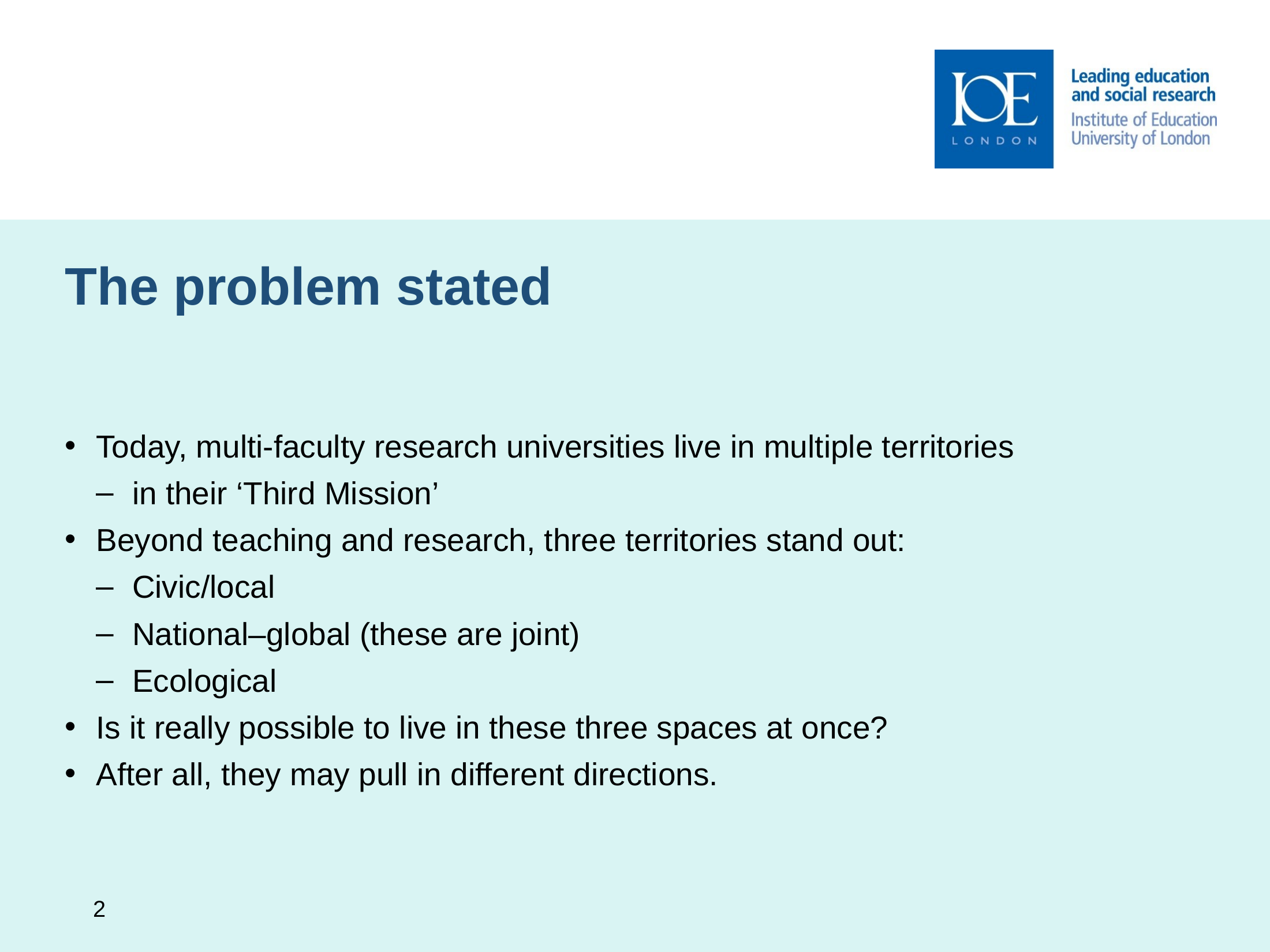
A multitude of challenges are coming at universities, which are being obliged to live, as it were, in different territories all at once.
In much of the world, we have been talking for about thirty years of the university’s Third Mission. Beyond teaching and research, universities are expected to engage with society.
This produces, I want to suggest, three big territories now in which universities could be operating: civic and local; national and global; and ecological.
Increasingly, there is talk about the regional challenges of universities.
And then there are wider national and global challenges, and I will put those two together. They contain, for example, issues about the technological environment and the international environment, and I see these coming through in your own policy thinking in Japan.
And then you have what I call the ecological territory.
I see in your own thinking in Japan that you are talking of wisdom, of culture, of the environment, and even of wellbeing. All these themes are coming through in your policy statements on higher education in Japan. And those, I would want to group together under the idea of the ecological.
So, three big spaces: the civic and the local; the national and global; and the environment in its totality, in short, the ecological.
And the question is: is it possible for a university to live in all three spaces at once, in a proper way? After all, they may be pulling the university in different directions.
So that is the problem that I will deal with in my talk with you today.
Slide 3 – Let’s Be Optimistic
Let’s be optimistic.
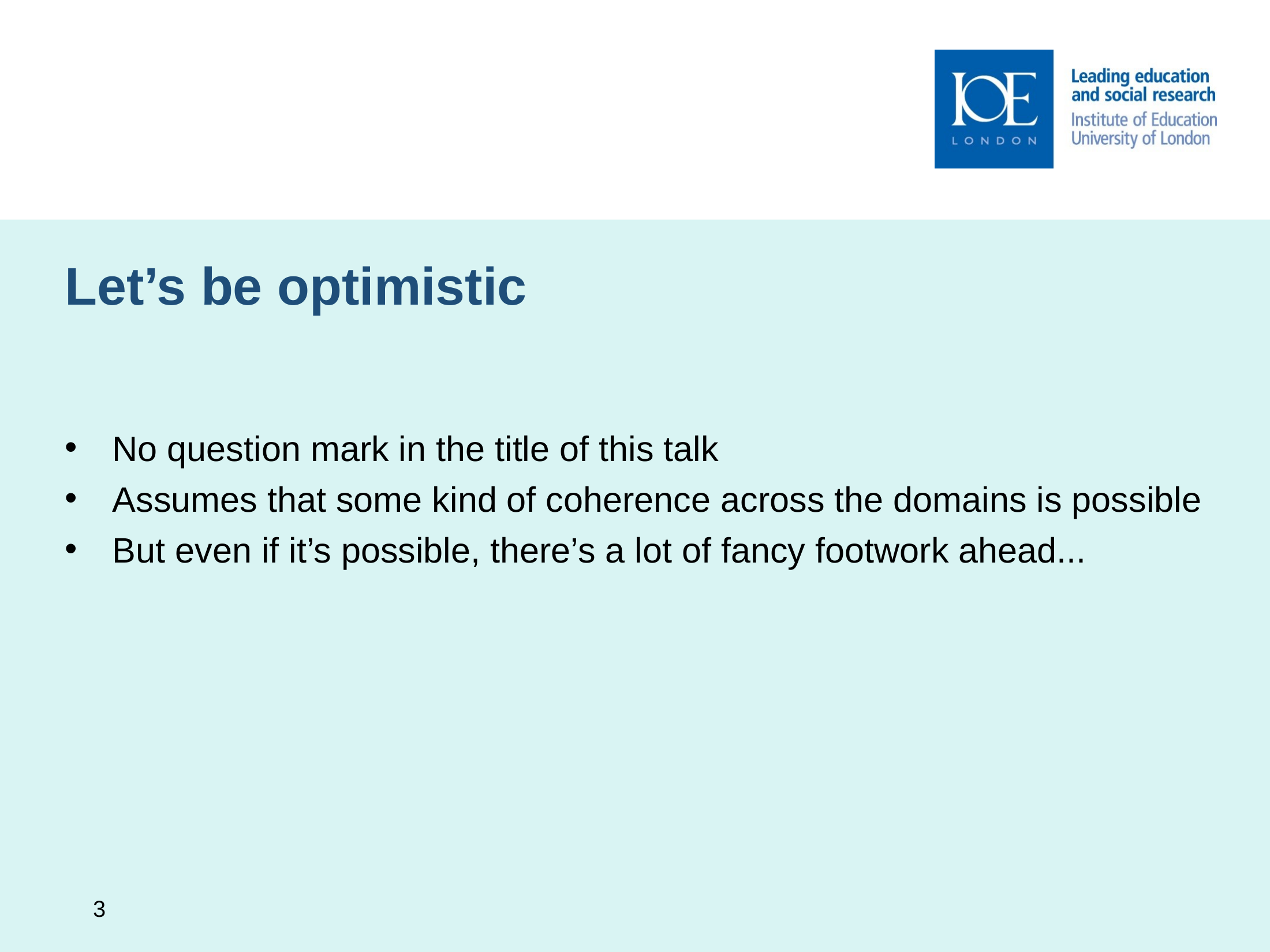
There is no question mark at the end of the title of my talk. I am suggesting that there is a major problem here, but I am not suggesting that it is impossible. I want to suggest that it is possible, but the question is: how do we produce the possible from the seemingly impossible?
There is no question mark in the title of my talk. I want to hope and believe that it is possible for the university to live in all three territories. And I want to hope that we can evolve some kind of coherence across those domains.
All universities in the world—and you are very conscious of this in Japan—are having to respond to all sorts of agendas and all sorts of challenges coming at them in all sorts of ways. How are we going to achieve all of those ends? Is it possible?
But if it is possible, we have got to do quite a lot more thinking as to how it is possible.
Slide 4 – Background
Let us identify some of the background here.
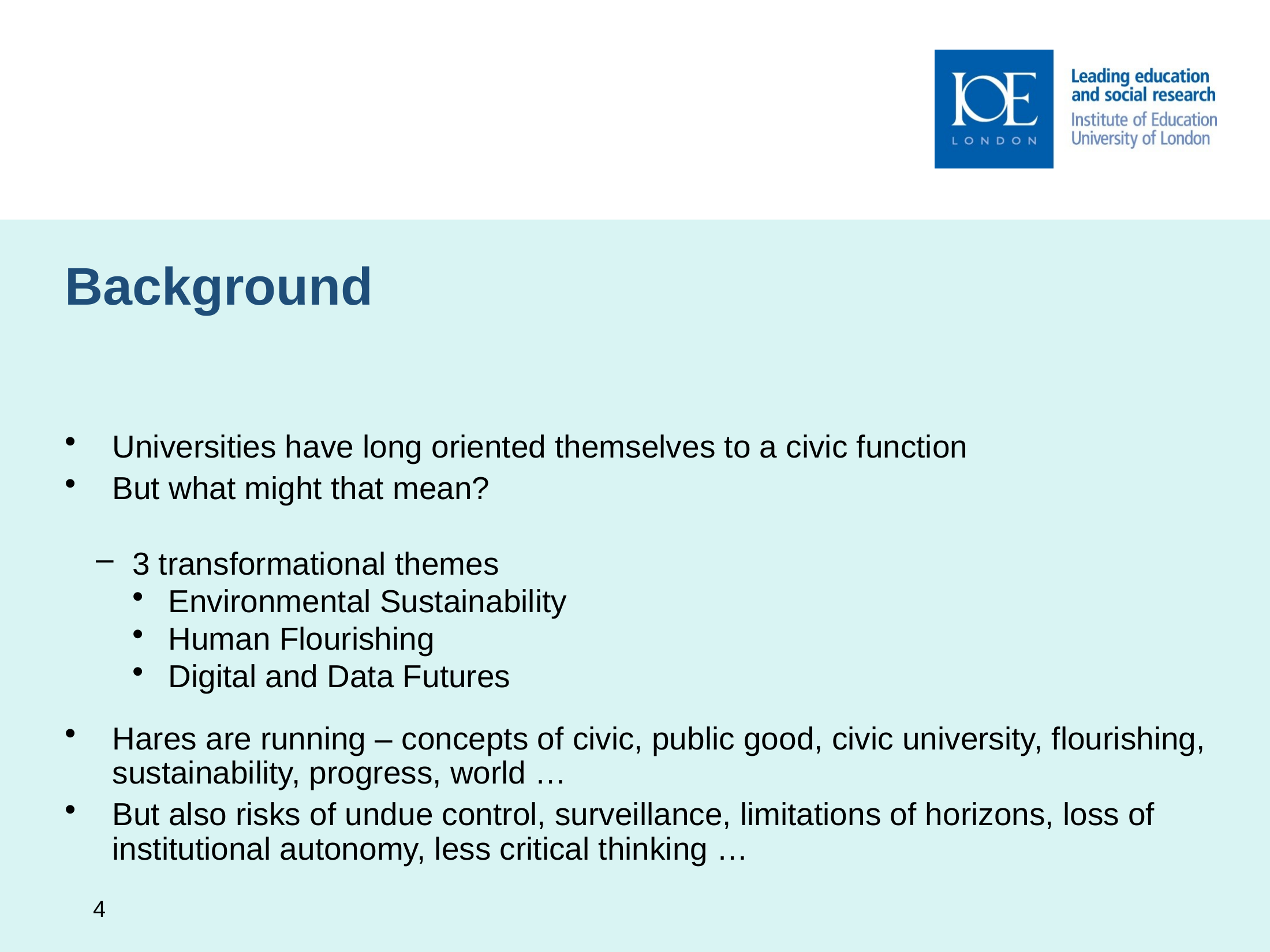
For a long time, perhaps for a hundred years or more, universities have considered that they have a civic function, as we speak of it in England. In the nineteenth century in England, we established a number of civic universities as they came to be called.
But what does it mean for a university to have a civic function?
Well, I think there are themes that we might now want to identify under that civic function: problems of environmental sustainability; human and community flourishing; and what it is to prosper and flourish in a digital age.
But once we start recognising those challenges, other challenges emerge very quickly: the concept of the public good; the concept of human flourishing; the concept of sustainability or progress; and of world development.
All these are big challenges for universities today.
And there are risks here, and challenges that are opening up across the world: problems of undue control by some governments over higher education; of digital surveillance; of a loss of institutional autonomy; of a limitation of horizons; and of less critical thinking.
All of these are risks that the world of higher education is facing these days, precisely as it opens up to these big challenges.
Slide 5 – Another Concept: That of “Ecological”
Another big concept that I want to put into the conversation is that of the ecological.
Now what do I mean by ecological?
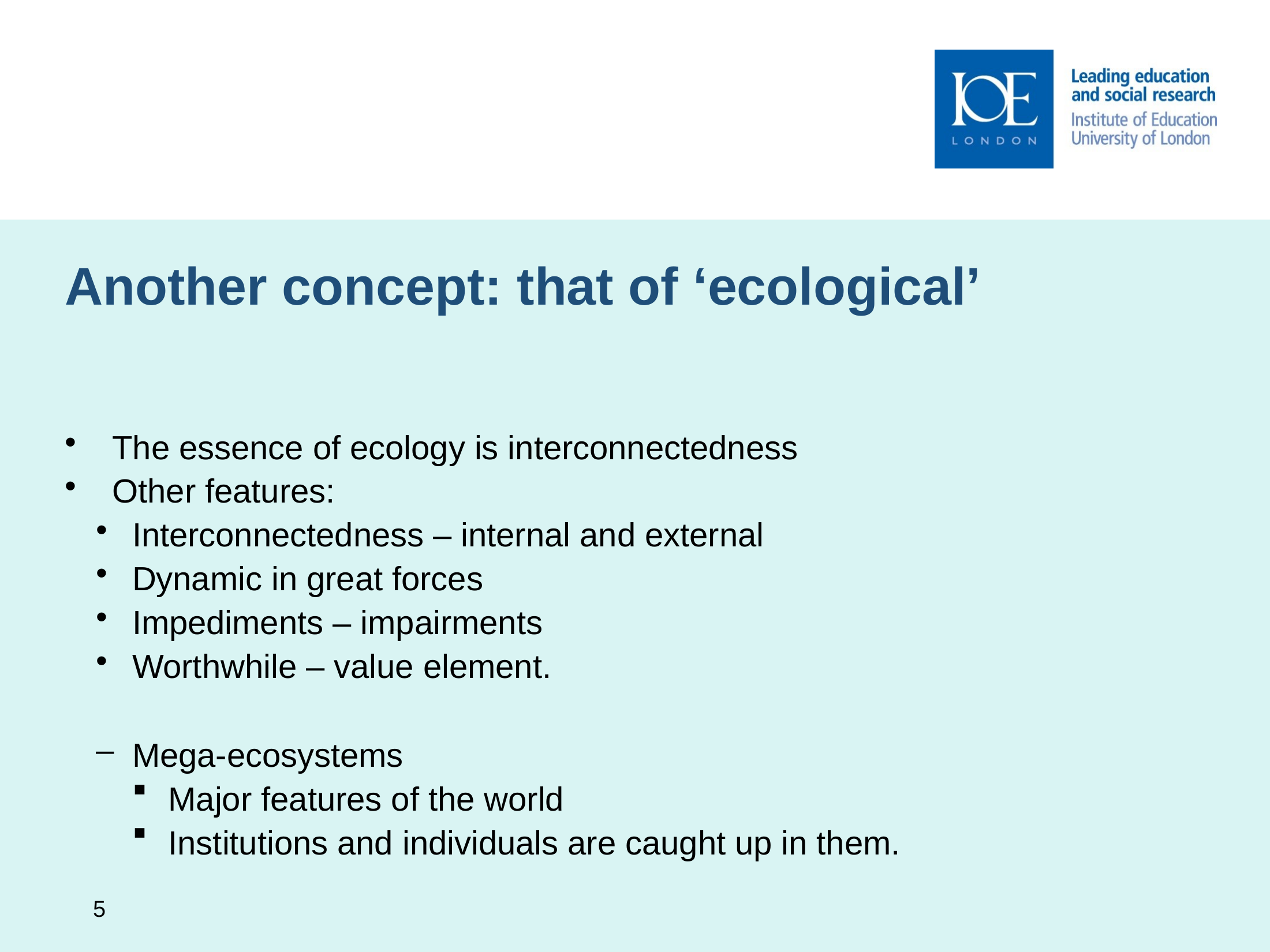
By ecological, I want to point to interconnectedness.
To be ecological means to have a sense of the way in which systems are themselves interconnected internally, but also a sense of their being connected with the wider world.
So their main feature is that of interconnectedness, internal and external.
But this is all happening within great dynamics, great forces.
This is how I visualise the world: huge mega-forces—ecosystems—which are interacting with each other and imposing themselves upon our great institutions like higher education and upon ourselves as individuals.
And they bring with them severe challenges.
First of all, all ecosystems are impaired. They are damaged. They are distorted in some way or another. They fall short of their possibilities. I will speak more about that in a moment.
These ecosystems are not pure and not wonderful. On the contrary, they are very often damaged. They are impaired. They suffer impediments.
But they are also intrinsically worthwhile. They are valuable. These ecosystems are hugely important to the world. They are worthwhile. To speak of ecosystems and ecology is to introduce a value element into our inquiries.
So there are these mega-ecosystems in the world. They are major features of the world, and both institutions and individuals are caught up in them and are affected by them.
They are not only out there; they are in us.
As I am speaking now with you today, those mega-systems are in me, whether I like it or not.
Slide 6 – No Title
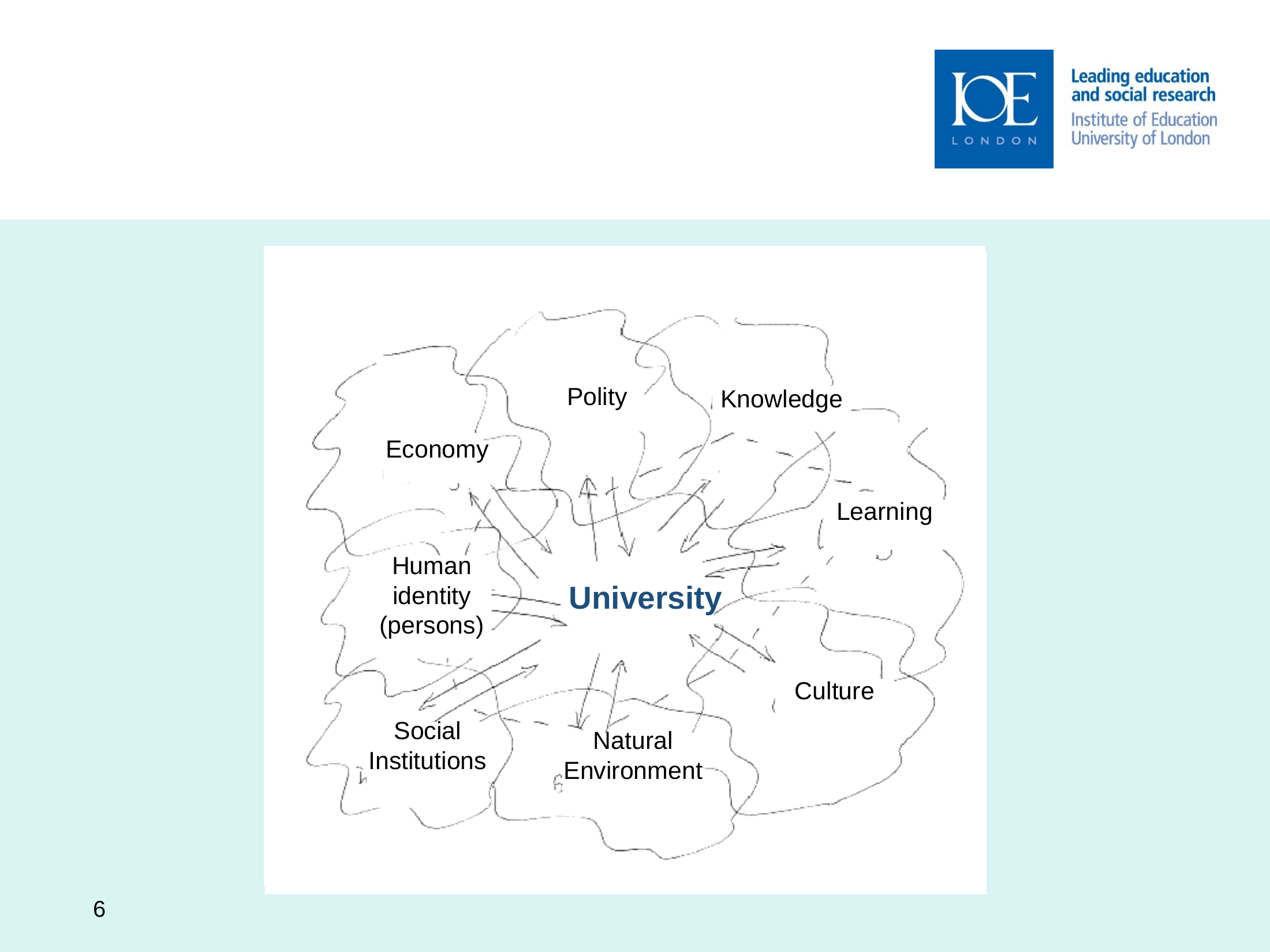
I am trying, in this diagram, to capture a sense of mega-ecosystems in and around the university.
So you have a fictional university at its heart, in the middle, and around it eight ecosystems: economy, politics, knowledge, learning, culture, the natural environment, social institutions, and human identity.
The university, any university across the world, is encircled by these eight ecosystems.
And since I drew that diagram, I would now have to put into it a ninth circle, and that is technology.
Technology is now a force in its own right, which straddles and invades all the other ecosystems.