Special Edition No. 1 · Ronald Barnett Lecture
Civic, Global, Ecological: Towards a Collaborative Mission for the University
Slide 13 – Tensions and Antagonisms
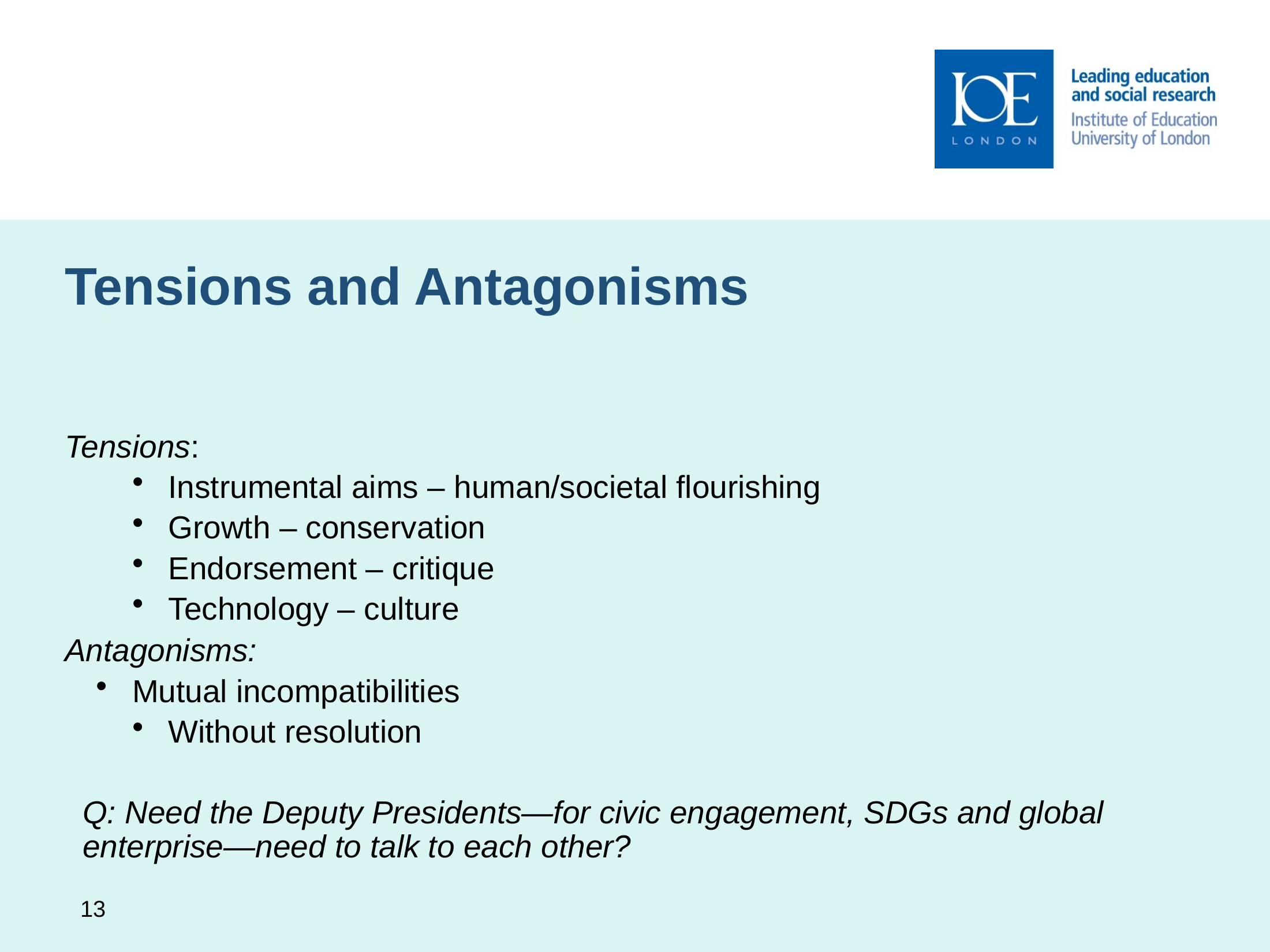
I am suggesting that there are major tensions and antagonisms here, and I think they lurk within the policy frameworks that are developing in Japan, or at least within the higher education system as I understand it.
There are tensions between being instrumental—getting things done to an identified aim—on the one hand, and being concerned with human and societal flourishing on the other.
I was fascinated to see, in one of the policy papers that was shared with me before my talk, that in Japan your policy circles recognise that not everything that is important and valuable in higher education can be measured.
I thought that was fantastic. I am afraid we do not always see that in governments across the world. For the most part, governments have come to believe that anything of value in higher education can—and therefore has to—be measured.
The instrumental dominates, while concerns about human and intellectual flourishing are much less in evidence, even if there is some discussion of them. There is a fundamental set of conflicts here.
Then there is another conflict between growth—economic growth—on the one hand, and conservation on the other.
Conservation is concerned with preserving what we have in the world.
The whole notion of sustainability, for example, is, in a sense, a conservative idea.
It pulls against the whole agenda of growth, and yet we pursue both growth and sustainability simultaneously. It is a profound tension.
Then we have another major tension between the university as a centre for critical thought and the university as a major vehicle for endorsing and fulfilling the expectations of society. Sometimes, the expectations of society deserve to be critiqued.
The university is, therefore, now in a difficult place across the world, caught between the challenge of being a critical centre and the expectation that it should largely provide society and the economy with what they ask of it.
In New Zealand, universities are required by statute to accept a role as “critic and conscience of society,” and they are also expected to endorse, support, faithfully respond to, and even energise society’s expectations.
Those expectations on the part of society may need to be critiqued, and sometimes governments and society do not wish to hear those critiques.
Then we come to technology and culture. Again, I was fascinated to see that higher education, within the Japanese government structure, is located in a ministry whose title includes Culture, namely the Ministry of Education, Culture, Sports, Science and Technology. That is an extraordinary range of responsibilities. And, importantly, Culture appears in the title.
Alongside science and technology, you have Culture. In fact, Culture precedes Science and Technology. That is highly unusual across the world. It reflects a hope, an expectation and a belief that Culture still matters, even in a technological world. Yet there are tensions between technology and culture. Sometimes these tensions become actual antagonisms—situations in which the incompatibilities are so deep that they cannot be overcome.
We cannot do justice both to the imperatives of technology on the one hand and to care and sensitivity towards culture and persons on the other. Ultimately, one may displace the other. These are antagonisms without resolution. They will go on. There is no way of solving these antagonisms. We have to live with them.
For example, imagine that your university has a Deputy President for Civic Engagement, another for the Sustainable Development Goals, another for Global Enterprise, and another for Artificial Intelligence.
The question is:
Do they ever need to talk to one another? And, if so, what would they talk about? Do they have any challenges in common? This is a real difficulty for management and leadership.
In the past I might have asked whether the Deputy President for Research and the Deputy President for Teaching needed to talk to each other. What was the connection between them? Today, however, fragmentation within universities has become much broader, more important, more intense and more challenging as universities seek to connect with society in all of its complexity.
Slide 14 – The Civic
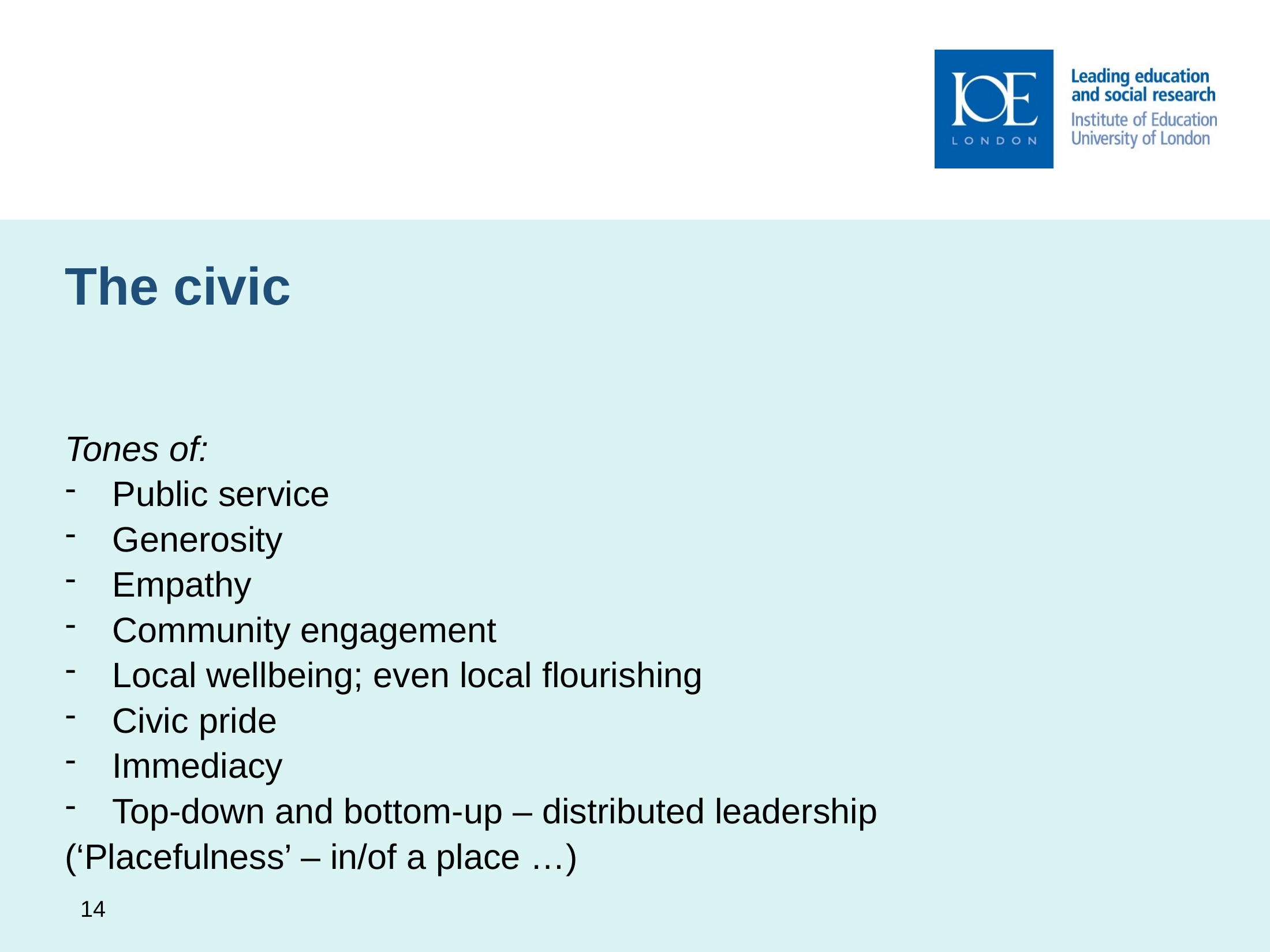
Remember that I am proposing these three major territories as confronting the university: the civic, the global, and the ecological. Let us look at the different languages and cultures that exist within these three agendas, beginning with the civic.
What are its values?
What are its ideas?
What are the concepts that become part of the civic agenda for any university that takes this agenda seriously?
You hear ideas of public service, community engagement, local wellbeing, even local flourishing, and civic pride.
You hear about listening to the local community, being generous towards it, understanding it, and showing empathy towards it.
You become concerned with poorer people and disadvantaged communities within a locality or region.
Then there is the desire to get things done with a sense of immediacy.
Activities with the local community can only be effective if there is a form of distributed leadership, in which leadership emerges within projects carried out in partnership with the locality, enabling the community itself to develop a sense of ownership.
The notion of place therefore becomes very interesting. Where is the place? Is it in the university? Or is it in the locality?
The civic agenda therefore becomes, as we may say in the West, a ballgame of its own.
Slide 15 – The Global
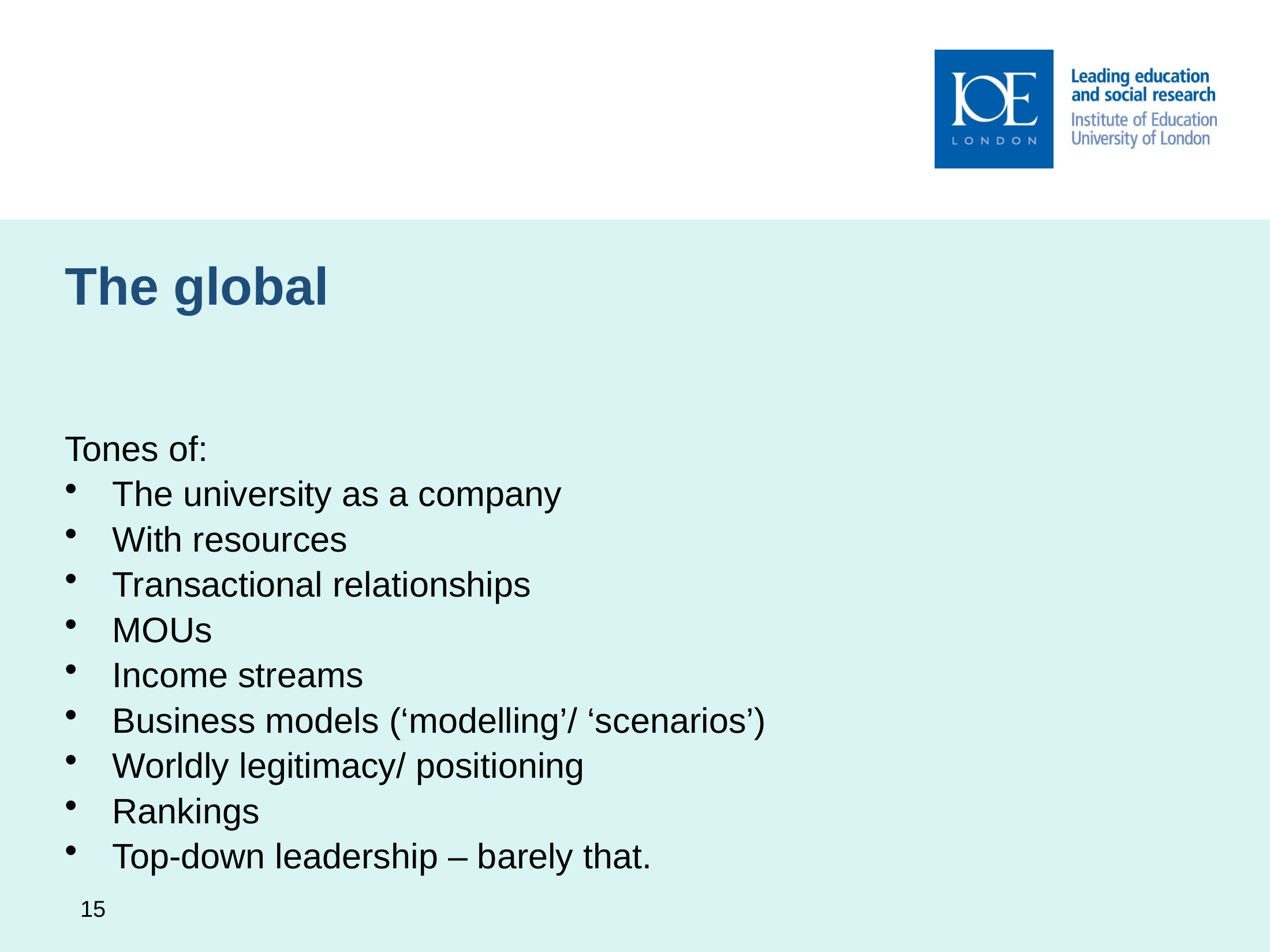
The global presents a different kind of horizon, a different set of communities, a different language, and a different way of being for the Deputy President who is concerned with, and has a responsibility towards, the university’s global agendas.
Here, the Vice-President understands that, in projecting the university internationally, the university almost becomes like a private company, with its own resources and its own possibilities for transactional relationships with other nations, other universities, and major corporations around the world. There is a great deal of activity: signing memoranda of understanding with other universities, with other nations, and with major corporations.
This Vice-President is concerned with a different set of priorities: widening the university’s income streams, developing business models, and constructing scenarios for the university over the next twenty or thirty years. The concern here is not only with the university’s position in the world rankings, but also with its legitimacy and its positioning in the world. How is the university understood worldwide?
Here, leadership becomes much more top-down. This Vice-President becomes all-knowing, all-seeing, understanding the university’s place in the world, and exercising a form of top-down leadership throughout the institution.
Slide 16 – The Ecological
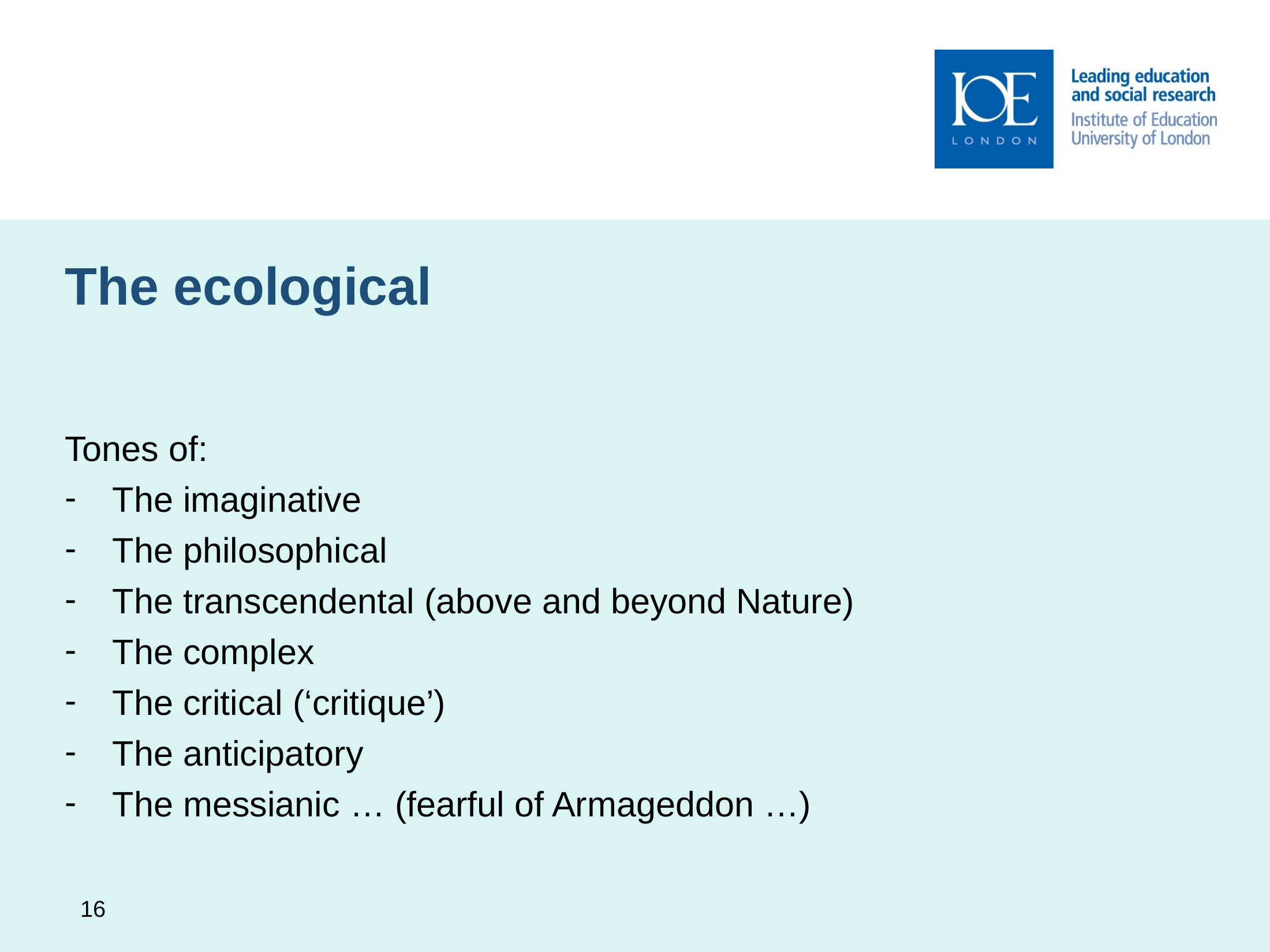
Next, the ecological territory—the ecological agenda.
Again, we encounter another kind of territory, another kind of agenda, with its own values and concepts. Here, one thinks into the future in quite a different way—not by simply extending where one is, but by imagining new possibilities for the university. One tries to imagine new kinds of universities within the ecosystem situation of a university—and that ecosystem situation will vary for each university. What are the possibilities for this university, or that university, in this extraordinarily interconnected, dynamic and evolving world? So this Vice-President becomes much more imaginative. The role becomes almost philosophical and almost poetic, asking what the value of the university is and imagining whether that value can be realised in new ways. It even becomes transcendental. It may lead us back into the culture and philosophy of Japan.
What are the traditions of Japan? What were they? What are they? How might they be realised in the twenty-first century?
What does it mean to respond now, given—for example—the extraordinary care for nature that exists in Japan?
This is a fundamental issue. There is a sense of a world beyond human beings—a transcendental world. How are universities going to take that on board?
Then we encounter the whole complexity of ideas and values, together with the notion of the university as a critical agent, helping society to reflect and to be critical of itself. Are we simply going to go headlong in the direction that the great powers want us to go? Or are we going to create space to reflect upon this, and help society to reflect upon it—to become a learning society?
Many people are now fearful of the direction in which the world is heading. Some even speak of Armageddon, of the complete destruction of systems on this earth.
Can we still be hopeful? What does it mean to be hopeful against this background? Some universities are now beginning to create spaces and units in which they can think much more imaginatively about how the university might move forward within this ecological horizon.
Slide 17 – A Multiplicitous Situation
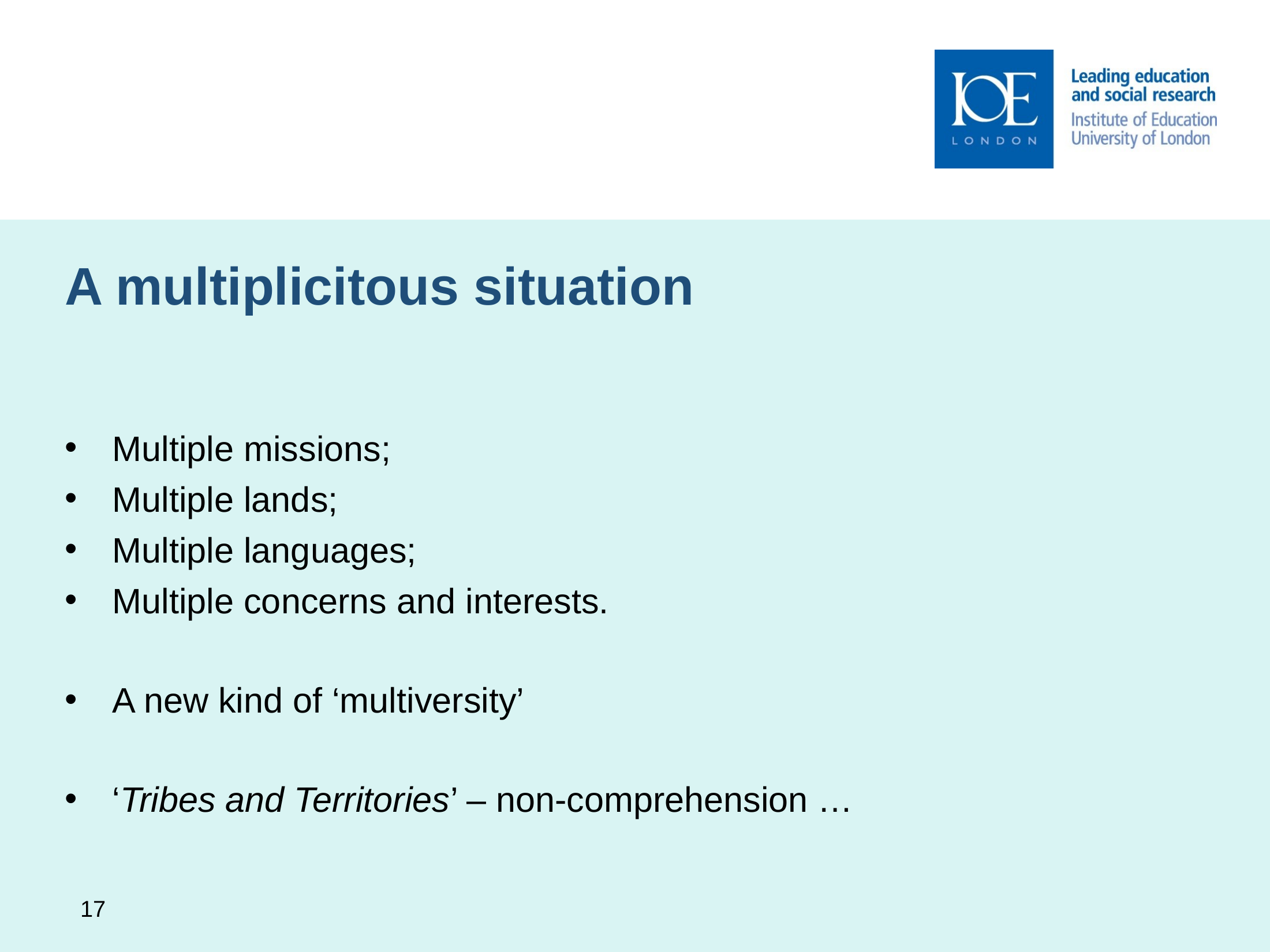
So this is what we might term a multiplicitous situation: multiple missions; multiple lands; multiple territories; multiple languages; multiple concerns and interests; and multiple values.
The university is having to live in all of these ways, in all of these territories, all at once. This is a new kind of multiversity.
A great friend and mentor of mine, Tony Becher, wrote a famous book in 1989 entitled Academic Tribes and Territories, in which he identified the academic tribes and territories within universities. Academics in philosophy, sociology, biology, and technology could not talk to each other very much because of the different territories, languages, and cultures within which they lived.
Now that challenge has expanded enormously because the university has to live in all of these external territories: the local, the global, and the ecological. It is a very difficult situation because these territories comprise different communities, each with its own language and expectations.
Slide 18 – Where’s the Unity?
And so the question arises:
Where’s the unity in all of this? Can there be unity?
Problem: there may be no unity at all. That may be the world in which we have to live.
Faced with all of those mega-ecosystems that I identified earlier, we may be in such a messy situation that there is no unity at all. This is fundamentally the messiness of what I term supercomplexity—different discourses, different languages, none of which can agree with one another. That is the challenge of being a university today.
Is institutional fragmentation under these conditions inevitable? That is the question that faces us.