Special Edition No. 1 · Ronald Barnett Lecture
Civic, Global, Ecological: Towards a Collaborative Mission for the University
Slide 19 – The University is Pulled into Multiple External Spaces
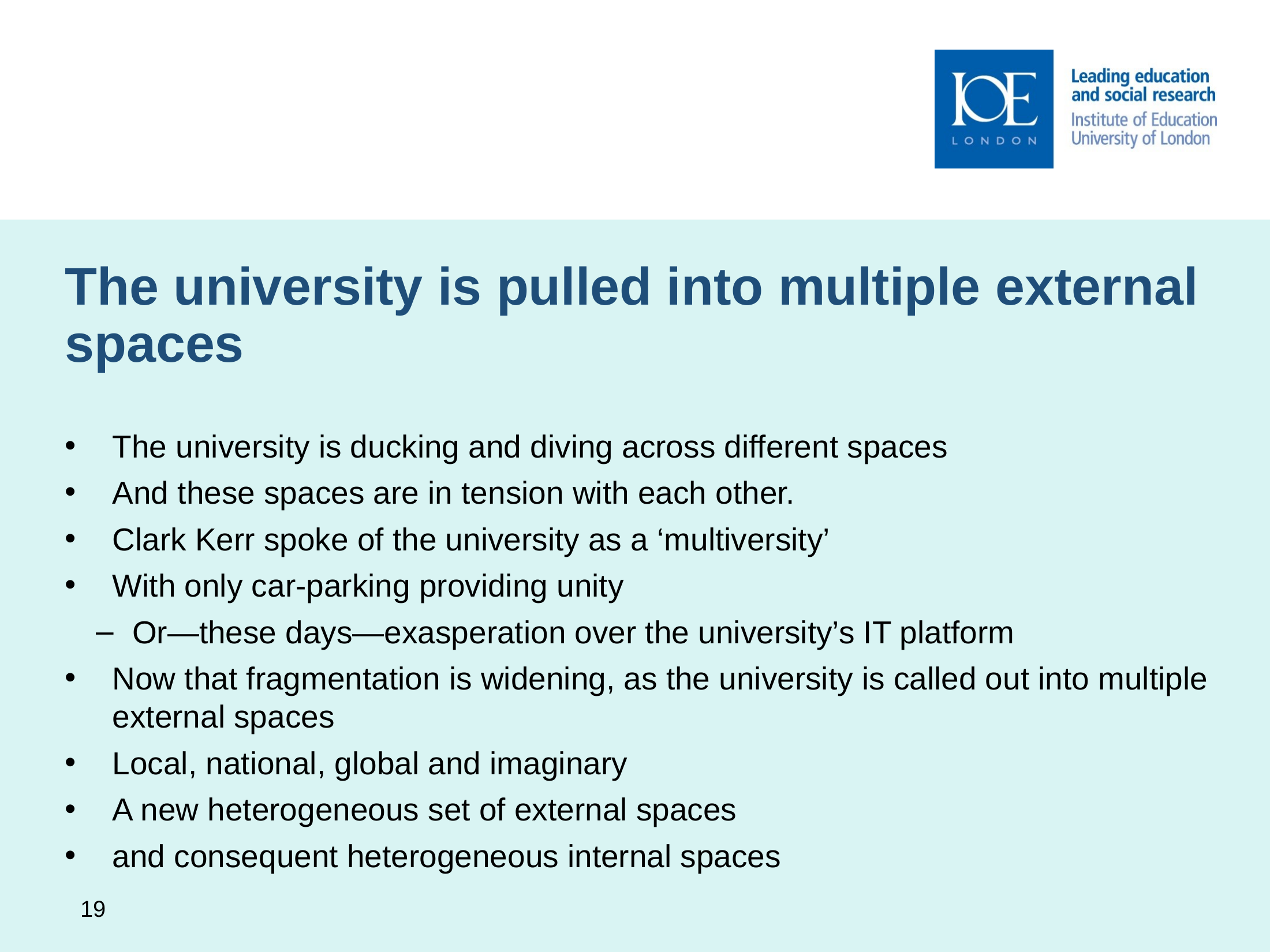
So the university is being pulled into multiple external spaces, whether it likes it or not, and these spaces are in tension with each other.
Clark Kerr, of the University of California, spoke some sixty years ago of the university as a multiversity, which was united, as he put it, only by a collective concern over car parking.
Well, the question is:
Do we have any collective concerns today? I suggest that, if we have one, it is a concern over the university’s IT and AI platforms and their operations.
That’s all that unites us in universities around the world today.
There is very little now that unites the university as it faces the different mega-challenges that the world is presenting.
This fragmentation is widening all the time, day by day, as the university is pulled outwards, locally, internationally, globally, and into real and imaginary spaces.
This is a new situation for the university. The external spaces into which it is being pulled are multiplying and are very different. They are heterogeneous.
As a consequence, the university develops heterogeneous internal spaces as it tries to respond to a messy and heterogeneous external world. So internal messiness responds to external messiness.
Slide 20 – Increasing External Heterogeneity
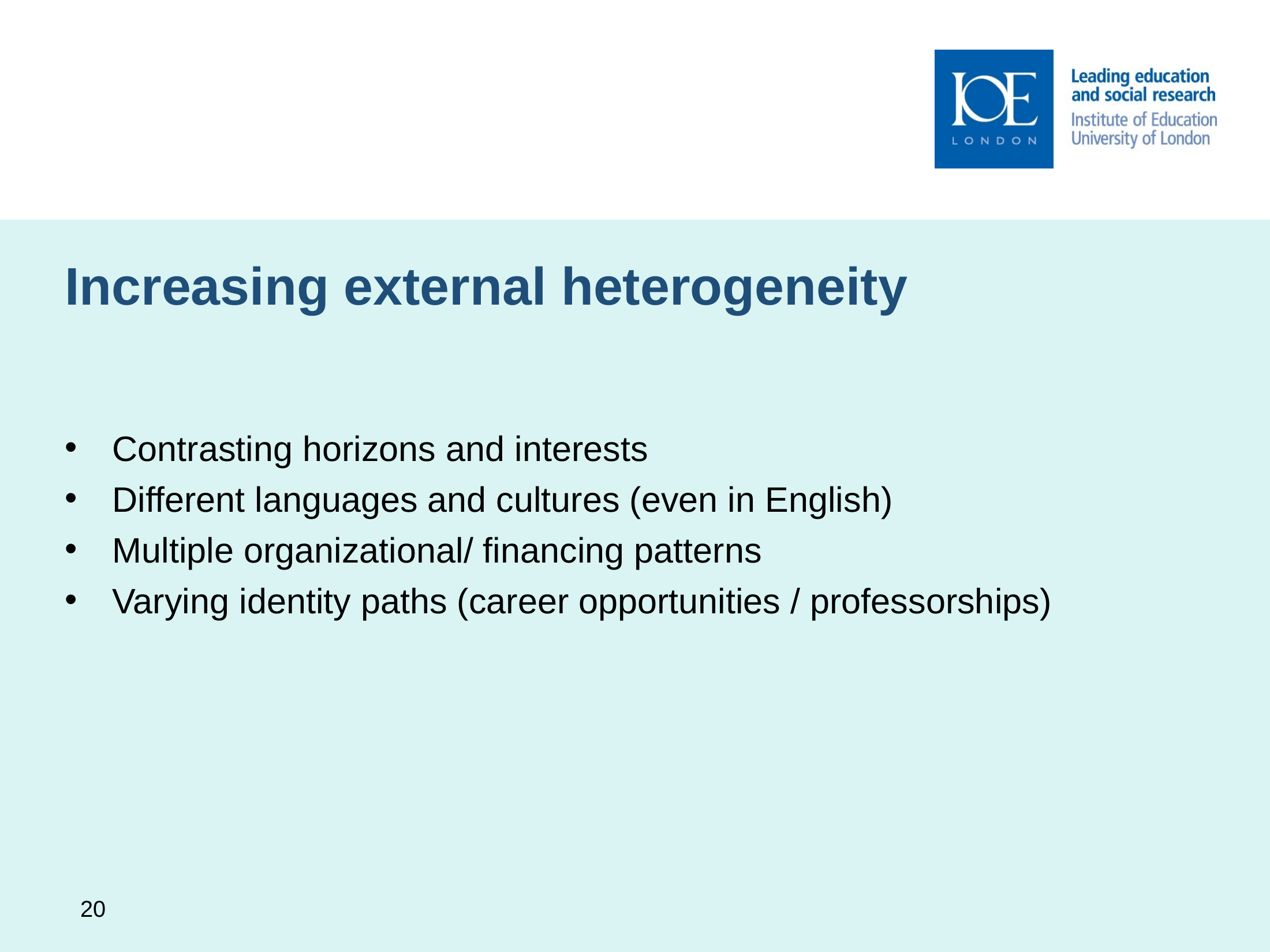
What I’m suggesting is that external constituencies are now expanding and pulling the university in all sorts of difficult and awkward ways. They have contrasting horizons and interests.
The interests of global AI technology corporations are quite different from concerns about the natural environment, personal and social flourishing, and the preservation and development of culture. These are fundamentally different interests, and we shouldn’t pretend that we can easily bring them together. They also exert enormous power.
Through them come new financial and other opportunities for universities. New career paths open up for different kinds of professors. The professor of modern languages tends to disappear, while professors of AI become increasingly numerous as the university is pulled into these different external spaces.
Slide 21 – A New Ethos: Living with Difference
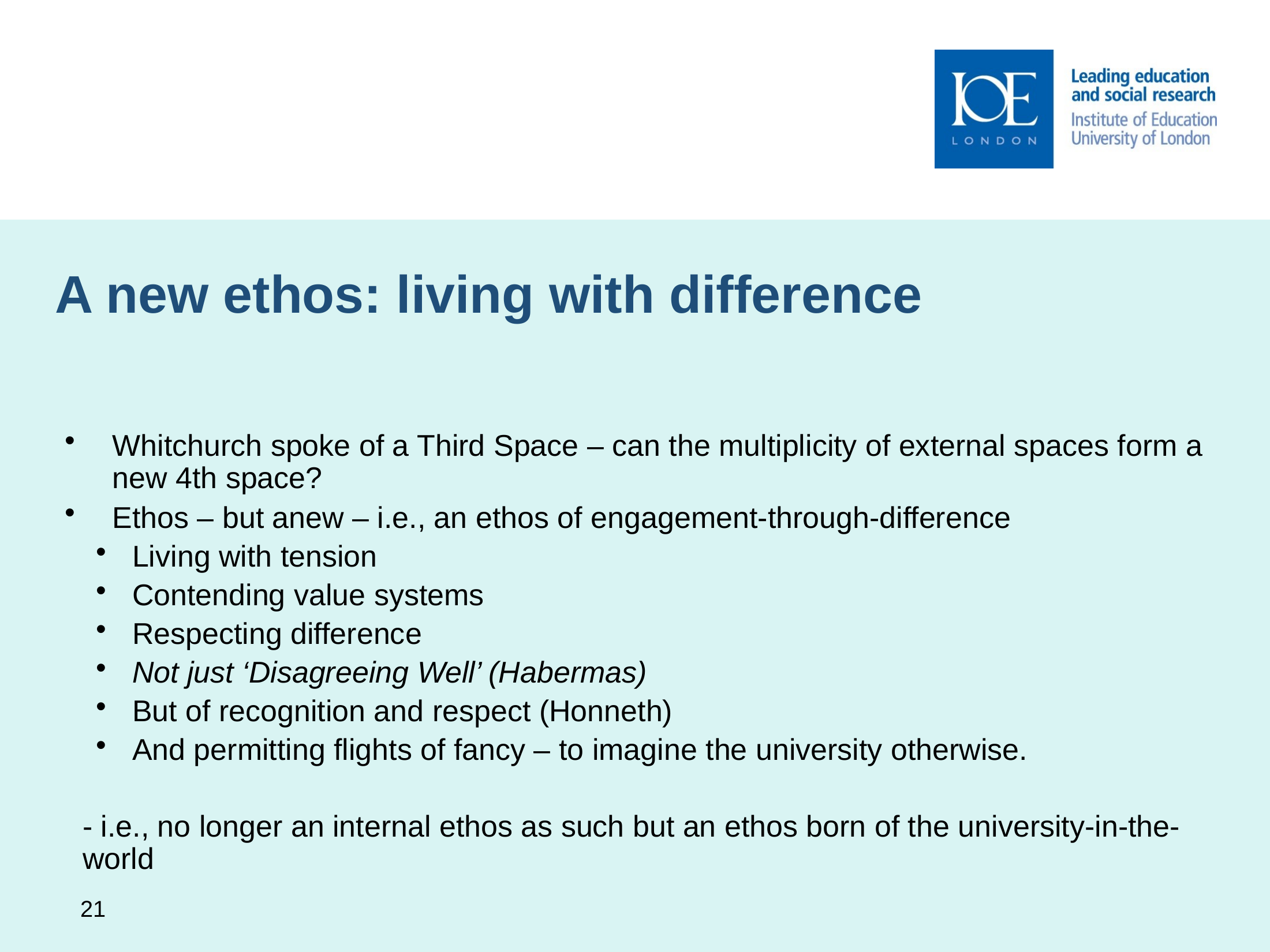
So the question is: Can a new ethos, a new culture, be developed for the university in which we can live with difference? This is the fundamental question facing university leadership today.
My colleague, Celia Whitchurch, spoke of a Third Space. She was talking about a third space of professionalism within universities, alongside teaching and research. But now the question arises as to whether a Fourth Space can be created in which the university finds a way of living with the difference that it is confronted with.
Living with tension. Living with its contending value systems. Respecting the differences across the system.
The great theorist Jürgen Habermas, who died earlier that year, spoke about just this matter.
Can we evolve ways of living with each other, talking with each other, in which we are rational with each other while living out our differences?
My own university—University College London—has taken this philosophical idea seriously and developed an initiative called Disagreeing Well. It is a major initiative at one of the world’s great universities. It brings people together to confront the major issues of the day over which there are conflicting ideas and interests.
My university is doing precisely that by identifying some big controversial issues of the day and bringing people together, opening up spaces for debate in which there can be real interpersonal recognition and respect.
Living with each other’s different points of view, and even trying to imagine the university otherwise. Imagine the university being quite a different kind of university.
This is not an internal process, not an internal language, but a language and a culture which recognises that the university is linked with, and involved in, the world. This is the new world in which the new university has to evolve.
Slide 22 – Practising the Ethos
So how do we do this? How do we evolve a new culture of the university in which we can live with difference, internally and externally? The problem is, as I was saying earlier, that the dominant forces are working against it. The dominant forces are pushing the university towards national economic growth, AI and technology, and explicit technological and economic aims and outcomes.
As the nation is now itself challenged by all sorts of economic and even social challenges, the economic world is coming into the university—not really to have a conversation with the university, but to push it in directions that serve its own interests. And it comes with its particular themes, terms and values.
You have a great challenge here in Japan with the declining birth rate. The government is pushing universities to think about this, to respond to it. That must be absolutely right. But that is just one example of the way in which the government is putting enormous pressure on universities to act in the national interest.
The question is: given the major interests of the world, society and government, as well as the claims of human flourishing and the flourishing of the natural environment, can we do justice to all of them together? It cannot be presumed that a positive answer is readily available.
Slide 23 – More Leadership, Less Management?
This is where leadership and management come into play. Both are profoundly important, but they differ profoundly.
I would put it this way: leadership first, and then management. Leadership is primary. Leadership helps to orchestrate the conversation, to bring in new ideas, and to open up horizons.
I have given you the example of the Disagreeing Well initiative at University College London, involving collaborative meetings of academics and professional staff at all levels.
When I was a senior leader at the Institute of Education, I had responsibility for producing its first corporate strategy. And we approached the matter in just that way, through conversations across the whole institution.
We brought academics and professional staff together to discuss really difficult matters about the future of the Institute of Education. Those were difficult conversations because people did not agree with one another. You could see it in their body language. They could barely look each other in the eye.
Characteristically, on these occasions, managers may reason in this way: “This is a waste of time. We know what the issues are. We know what the agenda is. We know what the goals should be. Let’s get on with it.”
Such an approach is misguided. This internal conversation is profoundly important. It is absolutely necessary if we are to develop the university as a collective agent that can engage with the world, with society, and with governments in a collective voice.
A major concept in thinking about university management is that of the university as a corporate agent. What does that mean? We have to work together; come together; act together.
Slide 24 – Conclusions
So, my conclusions.
The university is being called out into the wider world. The wider world is presenting the university with multiple agendas, each with its own communities. These agendas conflict. They emerge from external tribes and territories which conflict among themselves. So we are faced, as universities, with a new bewildering fragmentation that would tear the university apart.
There are frameworks of endorsement: get with the programme. Do what the nation wants you to do.
But there are other frameworks of social care, personal realisation and care for the natural environment.
How do we live with all these conflicts?
A new ethos is necessary. And it is possible. We have to find a way of living with strangeness. And it has to be worked at and fought for.
It’s very difficult. Is it even possible?
Thank you.